There was once upon a time a poor peasant called Crabb, who drove a load of wood with two oxen to town and sold it to a doctor for two talers. As the money was being counted out to him, the doctor happened to be sitting at table. When the peasant saw how well he ate and drank, his heart yearned for such a life, and he would willingly have been a doctor too. So he remained standing for a while and eventually asked if he, too, could become a doctor. ‘Oh, yes,’ said the doctor, ‘that is soon managed.’ ‘What must I do?’ asked the peasant. ‘First, buy yourself an A B C book, the kind that has a cock on the frontispiece. Second, sell your cart and your two oxen for money, and get yourself some clothes and whatever else pertains to medicine. Third, have a sign painted for yourself with the words: “I am Doctor Knowall,” and nail it up above your house-door.’ The peasant did everything he had been told to do. After he had doctored people for a while, but not for long, a rich and great lord had some money stolen. Then he was told about Doctor Knowall, who lived in such-and-such a village and surely knew what had become of the money. So the lord had his horses harnessed to his carriage, drove to the village, and asked Crabb if he were Doctor Knowall. Yes, he was, Crabb replied. Then he was to go with him and bring back the stolen money. ‘Oh, yes, but Grete, my wife, must go too.’ The lord was willing and let both of them have a seat in the carriage, and they all drove away together.
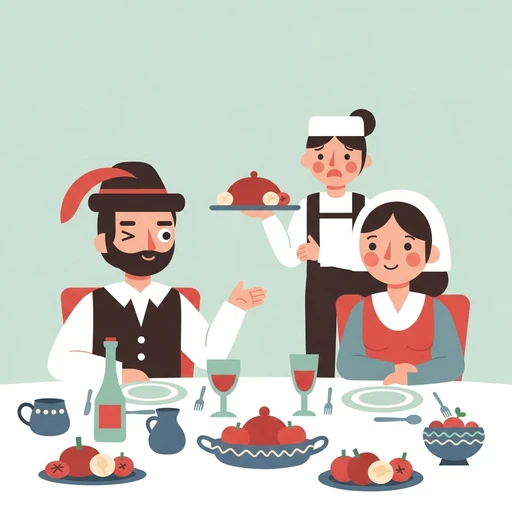
When they came to the nobleman’s castle, the table was spread, and Crabb was told to sit down and eat. ‘Yes, but my wife, Grete, too,’ he said, and he seated himself with her at the table. When the first servant came with a dish of delicate fare, the peasant nudged his wife and said: ‘Grete, that was the first,’ meaning he was the servant who brought the first dish. The servant, however, misunderstood, thinking Crabb meant to say: ‘That is the first thief.’ And as he actually was one, he was terrified. He said to his comrade outside: ‘The doctor knows all: we shall fare ill, he said I was the first.’ The second did not want to go in at all but was forced to. So when he went in with his dish, the peasant nudged his wife and said: ‘Grete, that is the second.’ This servant was equally alarmed and got out as fast as he could. The third fared no better, for the peasant again said: ‘Grete, that is the third.’ The fourth had to carry in a covered dish, and the lord told the doctor to show his skill and guess what was beneath the cover. Actually, there were crabs. The doctor looked at the dish, had no idea what to say, and cried: ‘Ah, poor Crabb.’ When the lord heard that, he cried: ‘There! he knows it; he must also know who has the money!’
On this, the servants looked terribly uneasy and made a sign to the doctor that they wished him to step outside for a moment. So when he went out, all four of them confessed that they had stolen the money. They said they would willingly restore it and give him a heavy sum into the bargain if he would not denounce them, for otherwise they would be sent to prison. They led him to the spot where the money was concealed. The doctor was satisfied with this and returned to the hall, sat down at the table, and said: ‘My lord, now I will search in my book for where the gold is hidden.’ The fifth servant, however, crept into the stove to hear if the doctor knew even more. But the doctor sat still, opened his A B C book, turned the pages back and forth, and looked for the cock. As he could not find it immediately, he said: ‘I know you are there, so you had better come out!’ Then the fellow in the stove thought the doctor meant him, and, full of terror, sprang out, crying: ‘That man knows everything!’ Then Doctor Knowall showed the lord where the money was, but he did not say who had stolen it. He received much money in reward from both sides and became a renowned man.

The end