There once lived a man and a woman who had long, but in vain, wished for a child. Finally, the woman hoped that God was about to grant her desire. These people had a small window at the back of their house, from which they could see a splendid garden, full of the most beautiful flowers and herbs. It was, however, surrounded by a high wall, and no one dared to enter it because it belonged to an enchantress, who held great power and was dreaded by all the world. One day, as the woman stood by this window, looking down into the garden, she saw a bed planted with the most beautiful rampion (rapunzel). It looked so fresh and green that she longed for it intensely; she pined away, becoming pale and miserable. Alarmed, her husband asked: ‘What ails you, dear wife?’ ‘Ah,’ she replied, ‘if I cannot eat some of the rampion from the garden behind our house, I shall die.’ Her loving husband thought: ‘Sooner than let your wife die, I must bring her some of that rampion myself, no matter the cost.’ At twilight, he clambered over the wall into the enchantress’s garden, hastily clutched a handful of rampion, and took it to his wife. She immediately made a salad of it and ate it greedily. It tasted so good to her—so very good—that the next day she longed for it three times as much as before. To ensure his wife's peace, her husband knew he must once more descend into the garden. In the gloom of evening, therefore, he let himself down again. But when he had clambered down the wall, he was terribly afraid, for he saw the enchantress standing before him. ‘How dare you,’ said she with an angry look, ‘descend into my garden and steal my rampion like a thief? You shall suffer for it!’ ‘Ah,’ he answered, ‘let mercy take the place of justice. I only made up my mind to do it out of dire necessity. My wife saw your rampion from the window and felt such a longing for it that she would have died if she had not gotten some to eat.’ Then the enchantress allowed her anger to soften and said to him: ‘If the case is as you say, I will allow you to take as much rampion as you wish, but I make one condition: you must give me the child your wife will bring into the world. It shall be well treated, and I will care for it like a mother.’ The man, in his terror, consented to everything. When the woman was brought to bed, the enchantress appeared at once, named the child Rapunzel, and took it away with her.
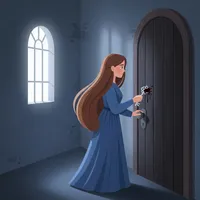
Rapunzel grew into the most beautiful child under the sun. When she was twelve years old, the enchantress shut her into a tower that stood in a forest. It had neither stairs nor door, but at the very top was a small window. When the enchantress wished to enter, she would place herself beneath the window and cry:
‘Rapunzel, Rapunzel, Let down your hair to me.’
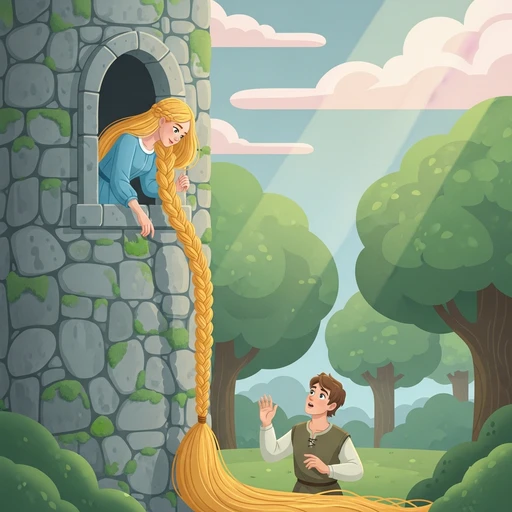
Rapunzel had magnificent long hair, fine as spun gold. When she heard the enchantress’s voice, she would unfasten her braided tresses, wind them around one of the window hooks above, and then her hair would fall twenty ells down, allowing the enchantress to climb up by it.
After a year or two, the king’s son rode through the forest and passed by the tower. He then heard a song so charming that he stood still and listened. It was Rapunzel, who, in her solitude, spent her time letting her sweet voice resound. The king’s son wanted to climb up to her and looked for a door to the tower, but none was to be found. He rode home, but the singing had so deeply touched his heart that every day he returned to the forest and listened to it. Once, as he stood hidden behind a tree, he saw the enchantress arrive and heard her cry:
‘Rapunzel, Rapunzel, Let down your hair to me.’
Then Rapunzel let down her braided hair, and the enchantress climbed up to her. ‘If that is the ladder by which one mounts, I too will try my fortune,’ he said. The next day, when it began to grow dark, he went to the tower and cried:
‘Rapunzel, Rapunzel, Let down your hair to me.’
Immediately, the hair fell down, and the king’s son climbed up.
At first, Rapunzel was terribly frightened when a man, such as her eyes had never yet beheld, came to her. But the king’s son began to talk to her as a friend, telling her that his heart had been so stirred that he had found no rest until he had seen her. Then Rapunzel lost her fear. When he asked if she would take him for her husband, and she saw that he was young and handsome, she thought: ‘He will love me more than old Dame Gothel does’; and she said yes, laying her hand in his. She said: ‘I will willingly go away with you, but I do not know how to get down. Bring a skein of silk with you every time you come, and I will weave a ladder. When it is ready, I will descend, and you will take me on your horse.’ They agreed that until that time, he should come to her every evening, for the old woman came by day. The enchantress noticed nothing of this until, one day, Rapunzel said to her: ‘Tell me, Dame Gothel, how it happens that you are so much heavier for me to draw up than the young king’s son—he is with me in a moment.’ ‘Ah! you wicked child,’ cried the enchantress. ‘What do I hear you say! I thought I had separated you from all the world, and yet you have deceived me!’ In her anger, she clutched Rapunzel’s beautiful tresses, wrapped them twice around her left hand, seized a pair of scissors with her right, and snip, snap, they were cut off, the lovely braids falling to the ground. And she was so pitiless that she took poor Rapunzel into a desert, where she had to live in great grief and misery.
On the same day that she cast out Rapunzel, however, the enchantress fastened the cut-off braids of hair to the window hook. When the king’s son came and cried:
‘Rapunzel, Rapunzel, Let down your hair to me.’
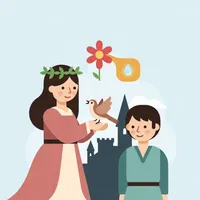
she let the hair down. The king’s son ascended, but instead of finding his dearest Rapunzel, he found the enchantress, who gazed at him with wicked, venomous looks. ‘Aha!’ she cried mockingly, ‘you would fetch your dearest, but the beautiful bird sits no longer singing in the nest; the cat has got it, and will scratch out your eyes as well. Rapunzel is lost to you; you will never see her again.’ The king’s son was beside himself with pain, and in his despair, he leapt down from the tower. He escaped with his life, but the thorns into which he fell pierced his eyes. Then he wandered, quite blind, about the forest, eating nothing but roots and berries, and doing naught but lament and weep over the loss of his dearest wife. Thus he roamed in misery for some years, until at last he came to the desert where Rapunzel lived in wretchedness with the twins she had given birth to—a boy and a girl. He heard a voice that seemed so familiar to him that he went towards it. As he approached, Rapunzel knew him and fell upon his neck, weeping.
Two of her tears wetted his eyes, and they grew clear again; he could see with them as before. He led her to his kingdom, where he was joyfully received, and they lived happily and contentedly for a long time afterwards.

The end