It was in the middle of winter, when broad flakes of snow were falling around, that a certain queen sat working at her window, the frame of which was made of fine black ebony. As she looked out upon the snow, she pricked her finger, and three drops of blood fell upon it. Then she gazed thoughtfully down at the red drops sprinkled on the white snow and said, "Would that my little daughter might be as white as that snow, as red as the blood, and as black as the ebony window-frame!" And so the little girl grew up; her skin was as white as snow, her cheeks as rosy as blood, and her hair as black as ebony. She was called Snow-White.
But this queen died, and the king soon married another wife. She was very beautiful, but so proud that she could not bear to think that anyone could surpass her. She had a magical looking-glass, to which she often went to gaze upon herself and say—
"Tell me, glass, tell me true!
Of all the ladies in the land,
Who is fairest? tell me who?"
And the glass answered, "Thou, Queen, art fairest in the land."
But Snow-White grew more and more beautiful. When she was seven years old, she was as bright as the day and fairer than the queen herself. Then one day, when the queen went to consult the glass as usual, it answered—
"Thou, Queen, may'st fair and beauteous be,
But Snow-White is lovelier far than thee?"
When the queen heard this, she turned pale with rage and envy, and, calling to one of her servants, said, "Take Snow-White away into the wide wood, that I may never see her more." Then the servant led the little girl away. But his heart melted when she begged him to spare her life, and he said, "I will not hurt thee, thou pretty child." So he left her there alone. Though he thought it most likely that the wild beasts would tear her to pieces, he felt as if a great weight were lifted from his heart once he had made up his mind not to kill her, but to leave her to her fate.
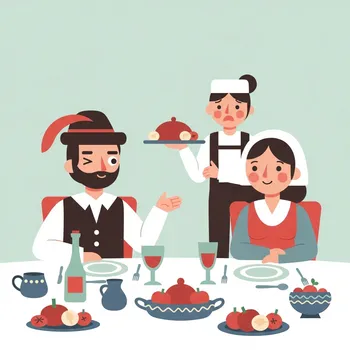
Then poor Snow-White wandered along through the wood in great fear. The wild beasts roared around her, but none did her any harm. In the evening, she came to a little cottage and went inside to rest, for her weary feet would carry her no further. Everything in the cottage was spruce and neat: on the table was spread a white cloth; there were seven little plates with seven little loaves and seven little glasses with wine in them; knives and forks were laid in order; and by the wall stood seven little beds. Then, as she was exceedingly hungry, she picked a little piece off each loaf and drank a very little wine out of each glass. After that, she thought she would lie down and rest. So she tried all the little beds: one was too long, and another was too short, until, at last, the seventh suited her. There she laid herself down and went to sleep. Presently, in came the masters of the cottage. They were seven little dwarfs who lived among the mountains, digging and searching for gold. They lit up their seven lamps and immediately saw that all was not right. The first said, "Who has been sitting on my stool?" The second, "Who has been eating off my plate?" The third, "Who has been picking at my bread?" The fourth, "Who has been meddling with my spoon?" The fifth, "Who has been handling my fork?" The sixth, "Who has been cutting with my knife?" The seventh, "Who has been drinking my wine?" Then the first looked around and said, "Who has been lying on my bed?" The rest came running to him, and everyone cried out that somebody had been upon his bed. But the seventh saw Snow-White and called upon his brethren to come and look at her. They cried out with wonder and astonishment, and bringing their lamps, gazed upon her, saying, "Good heavens! what a lovely child she is!" They were delighted to see her and took care not to waken her. The seventh dwarf slept an hour with each of the other dwarfs in turn until the night was gone.
In the morning, Snow-White told them all her story. They pitied her and said that if she would keep all things in order, and cook and wash, and knit and spin for them, she might stay where she was, and they would take good care of her. Then they went out all day long to their work, seeking gold and silver in the mountains. Snow-White remained at home, and they warned her, saying, "The queen will soon find out where you are, so take care and let no one in." But the queen, now believing Snow-White to be dead, was certain that she was the handsomest lady in the land. So she went to her glass and said—
"Tell me, glass, tell me true!
Of all the ladies in the land,
Who is fairest? tell me who?"
And the glass answered—
"Thou, Queen, thou are fairest in all this land;
But over the Hills, in the greenwood shade,
Where the seven dwarfs their dwelling have made,
There Snow-White is hiding; and she
Is lovelier far, O Queen, than thee."
Then the queen was very much alarmed, for she knew that the glass always spoke the truth, and she was sure that the servant had betrayed her. As she could not bear to think that anyone lived who was more beautiful than she, she disguised herself as an old pedlar woman and went her way over the hills to the place where the dwarfs dwelt. Then she knocked at the door and cried, "Fine wares to sell!" Snow-White looked out of the window and said, "Good day, good woman; what have you to sell?" "Good wares, fine wares," she replied, "laces and bobbins of all colors." "I will let the old lady in; she seems to be a very good sort of a body," thought Snow-White. So she ran down and unbolted the door. "Bless me!" said the woman. "How badly your stays are laced. Let me lace them up with one of my nice new laces." Snow-White did not dream of any mischief, so she stood up before the old woman. The woman set to work so nimbly and pulled the lace so tightly that Snow-White lost her breath and fell down as if she were dead. "There's an end of all thy beauty," said the spiteful queen, and went home.
In the evening, the seven dwarfs returned. I need not say how grieved they were to see their faithful Snow-White stretched upon the ground, motionless, as if she were quite dead. However, they lifted her up, and when they discovered what was the matter, they cut the lace. In a little time, she began to breathe and soon came to herself again. Then they said, "The old woman was the queen! Take care another time, and let no one in."
When the queen got home, she went to her glass and spoke to it, but to her surprise, it replied in the same words as before.
Then the blood ran cold in her heart with spite and malice to hear that Snow-White still lived. She dressed herself up again in a disguise, very different from the one she wore before, and took with her a poisoned comb. When she reached the dwarfs' cottage, she knocked at the door and cried, "Fine wares to sell!" But Snow-White said, "I dare not let anyone in." Then the queen said, "Only look at my beautiful combs," and gave her the poisoned one. It looked so pretty that the little girl took it up and put it into her hair to try it. But the moment it touched her head, the poison was so powerful that she fell down senseless. "There you may lie," said the queen, and went on her way. But by good luck, the dwarfs returned very early that evening. When they saw Snow-White lying on the ground, they knew what had happened and soon found the poisoned comb. When they took it away, she recovered and told them all that had passed. They warned her once more not to open the door to anyone.
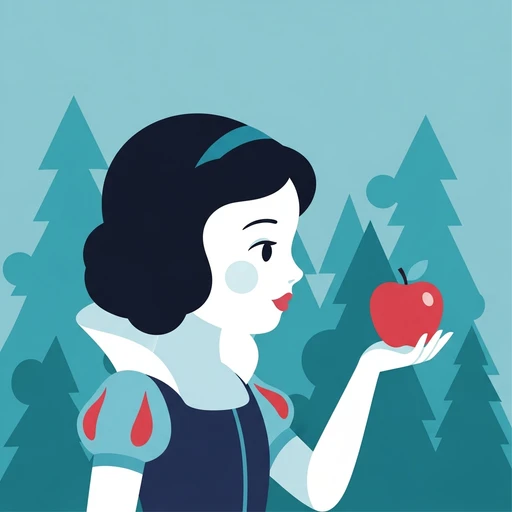
Meantime, the queen went home to her glass and trembled with rage when she received exactly the same answer as before. She said, "Snow-White shall die, if it costs me my life." So she went secretly into a chamber and prepared a poisoned apple. Its outside looked very rosy and tempting, but whoever tasted it was sure to die. Then she dressed herself up as a peasant's wife and traveled over the hills to the dwarfs' cottage. She knocked at the door, but Snow-White put her head out of the window and said, "I dare not let anyone in, for the dwarfs have told me not to." "Do as you please," said the old woman, "but at any rate, take this pretty apple; I will make you a present of it." "No," said Snow-White, "I dare not take it." "You silly girl!" answered the other. "What are you afraid of? Do you think it is poisoned? Come! You eat one part, and I will eat the other."
Now the apple was so prepared that one side was good, though the other was poisoned. Then Snow-White was very much tempted to taste, for the apple looked exceedingly nice. When she saw the old woman eat, she could refrain no longer. But she had scarcely put the piece into her mouth when she fell down dead upon the ground. "This time nothing will save thee," said the queen. She went home to her glass, and at last it said—"Thou, Queen, art the fairest of all the fair." Then her envious heart was glad, as happy as such a heart could be.
When evening came and the dwarfs returned home, they found Snow-White lying on the ground. No breath passed her lips, and they were afraid that she was quite dead. They lifted her up, combed her hair, and washed her face with wine and water. But all was in vain. So they laid her down upon a bier, and all seven watched and bewailed her for three whole days. Then they proposed to bury her, but her cheeks were still rosy, and her face looked just as it did while she was alive. So they said, "We will never bury her in the cold ground." They made a coffin of glass so that they might still look at her and wrote her name upon it in golden letters, noting that she was a king's daughter. Then the coffin was placed upon the hill, and one of the dwarfs always sat by it to watch. The birds of the air came, too, and bemoaned Snow-White. First of all came an owl, then a raven, but at last, a dove.
Thus Snow-White lay for a long, long time and still only looked as though she were asleep, for she was even now as white as snow, as red as blood, and as black as ebony. At last, a prince came and called at the dwarfs' house. He saw Snow-White and read what was written in golden letters. Then he offered the dwarfs money and earnestly prayed them to let him take her away. But they said, "We will not part with her for all the gold in the world." At last, however, they had pity on him and gave him the coffin. But the moment he lifted it up to carry it home with him, the piece of apple fell from between her lips, and Snow-White awoke, exclaiming, "Where am I!"
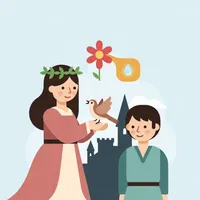
The prince answered, "Thou art safe with me." Then he told her all that had happened and said, "I love you better than all the world; come with me to my father's palace, and you shall be my wife." Snow-White consented and went home with the prince. Everything was prepared with great pomp and splendor for their wedding.
To the feast was invited, among the rest, Snow-White's old enemy, the queen. As she was dressing herself in fine, rich clothes, she looked in the glass and said, "Tell me, glass, tell me true! Of all the ladies in the land, Who is fairest? tell me who?" And the glass answered, "Thou, lady, art the loveliest here, I ween; But lovelier far is the new-made queen."
When she heard this, the queen started with rage. But her envy and curiosity were so great that she could not help setting out to see the bride. When she arrived and saw that it was no other than Snow-White, whom she thought had been dead a long while, she choked with passion, fell ill, and died. But Snow-White and the prince lived and reigned happily over that land for many, many years.

The end