Truly, the largest green leaf in this country is a dock-leaf. Held before one, it is like a whole apron; and held over one's head in rainy weather, it is almost as good as an umbrella, for it is immensely large. The burdock never grows alone; where one grows, several always grow. This abundance is a great delight, and all of it is snails' food. The great white snails—which persons of quality in former times made fricassees of, ate, and would exclaim, “Hem, hem! how delicious!” because they found them so delicate—lived on dock-leaves, and for this reason, burdock seeds were sown.
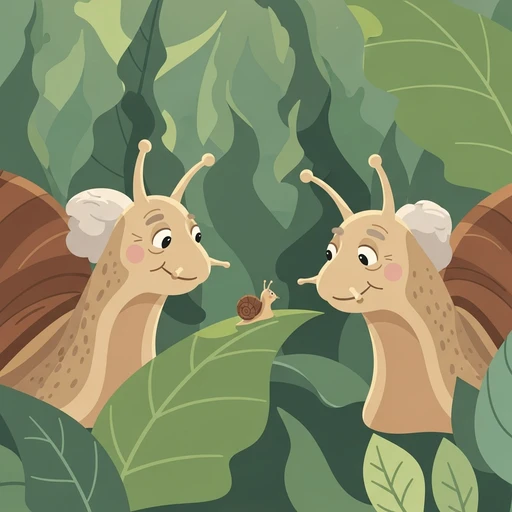
Now, there was an old manor-house where the custom of eating snails had quite died out. But the burdocks were not extinct; they grew and grew all over the walks and beds. No one could get the mastery over them—it was a whole forest of burdocks. Here and there stood an apple and a plum-tree; otherwise, one would never have thought it was a garden. All was burdocks, and there lived the two last venerable old snails.
They themselves knew not how old they were, but they could very well remember that there had once been many more of their kind; that they were of a family from foreign lands, and that for them and theirs the whole forest had been planted. They had never been outside it, but they knew that there was still something more in the world, which was called the manor-house. There, they believed, snails were boiled, became black, and were then placed on a silver dish. But what happened beyond that, they knew not; in fact, what it truly meant to be boiled and to lie on a silver dish, they could not possibly imagine. Yet, it was said to be delightful and particularly genteel. Neither the chafers, the toads, nor the earth-worms, whom they asked, could give them any information—none of them had been boiled or laid on a silver dish.
The old white snails, they knew, were the first persons of distinction in the world; the forest had been planted for their sakes, and the manor-house existed so that they might be boiled and laid on a silver dish.
Now they lived a very lonely and happy life. As they had no children themselves, they had adopted a little common snail, whom they brought up as their own. However, the little one would not grow, for he was of a common family. But the old ones, especially Dame Mother Snail, thought they could observe how he increased in size, and she begged Father Snail that if he could not see it, he would at least feel the little snail's shell. And then he felt it, and found the good dame was right.
One day there was a heavy storm of rain.
“Hear how it beats like a drum on the dock-leaves!” said Father Snail.
“There are also raindrops!” said Mother Snail. “And now the rain pours right down the stalk! You will see, it will be wet here! I am very happy to think that we have our good house, and the little one has his also! Surely, more is done for us than for all other creatures; but can you not see that we are folks of quality in the world? We are provided with a house from our birth, and the burdock forest is planted for our sakes! I should like to know how far it extends, and what there is outside!”
“There is nothing at all,” said Father Snail. “No place can be better than ours, and I have nothing to wish for!”
“Yes,” said the dame. “I would willingly go to the manor-house, be boiled, and laid on a silver dish; all our forefathers were treated so; there is something extraordinary in it, you may be sure!”
“The manor-house has most likely fallen to ruin!” said Father Snail. “Or the burdocks have grown up over it, so that we cannot come out. There is no need, however, for any haste about that; but you are always in such a tremendous hurry, and the little one is beginning to be the same. Has he not been creeping up that stalk for these three days? It gives me a headache when I look up to him!”
“You must not scold him,” said Mother Snail. “He creeps so carefully; he will afford us much pleasure—and we have nothing but him to live for! But have you not thought of it? Where shall we get a wife for him? Do you not think there are some of our species far away in the interior of the burdock forest?”
“I dare say there are enough black snails,” said the old one. “Black snails without a house—but they are so common and conceited. But we might give the ants a commission to look for us; they run to and fro as if they had something to do, and they certainly know of a wife for our little snail!”
“I know one, sure enough—the most charming one!” said one of the ants. “But I am afraid we shall hardly succeed, for she is a queen!”
“That is nothing!” said the old folks. “Has she a house?”
“She has a palace!” said the ant. “The finest ant palace, with seven hundred passages!”
“I thank you!” said Mother Snail. “Our son shall not go into an ant-hill; if you know nothing better than that, we shall give the commission to the white gnats. They fly far and wide, in rain and sunshine; they know the whole forest here, both within and without.”
“We have a wife for him,” said the gnats. “A hundred human paces from here sits a little snail in her house, on a gooseberry bush; she is quite lonely and old enough to be married. It is only a hundred human paces!”
“Well, then, let her come to him!” said the old ones. “He has a whole forest of burdocks, she has only a bush!”
And so they went and fetched little Miss Snail. It was a whole week before she arrived; but that was for the best, for one could thus see that she was of the same species.
And then the marriage was celebrated. Six earth-worms shone as well as they could. In other respects, the whole affair went off very quietly, for the old folks could not bear noise and merriment; but old Dame Snail made a brilliant speech. Father Snail could not speak; he was too deeply affected. And so they gave them as a dowry and inheritance the whole forest of burdocks, and said—what they had always said—that it was the best in the world; and if they lived honestly and decently, and increased and multiplied, they and their children would, in the course of time, come to the manor-house, be boiled black, and laid on silver dishes. After this speech, the old ones crept into their shells and never more came out. They slept; the young couple governed in the forest and had a numerous progeny, but they were never boiled and never came on the silver dishes. From this, they concluded that the manor-house had fallen to ruins, and that all the men in the world were extinct; and as no one contradicted them, so, of course, it was so.
And the rain beat on the dock-leaves to make drum-music for their sakes, and the sun shone in order to give the burdock forest color for their sakes. And they were very happy, and the whole family was happy, for they indeed were so.

The end