In Copperfield, mornings were made of sounds. The bakery door would open, releasing the scent of cinnamon as baking trays clinked against each other. Above the stream, the bridge's wires buzzed thinly when the wind caught them, and in front of the bicycle shop, the spokes sometimes softly pinged, as if greeting with downcast eyes. Sophie collected these sounds with invisible pins: into her sound-notebook she drew not letters, but wavy lines, alongside colors and fleeting remarks. "Rustling – yellow. Clink – silver. Clatter – ice blue."
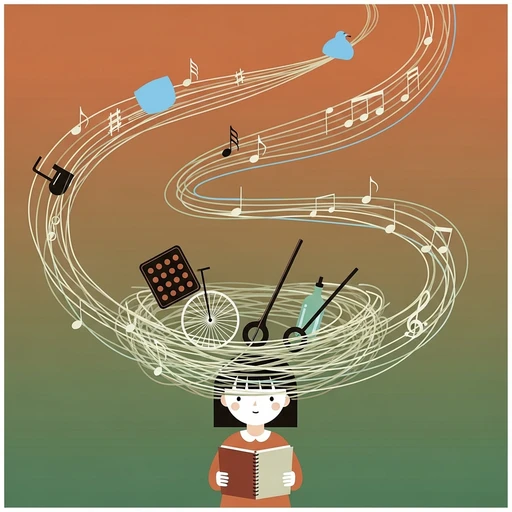
One Tuesday, however, she heard a sound such as never before. It was like a thin, striped scarf swishing past her head, a melody that didn't stop anywhere. It touched the leaves of trees, twanged the stamp pads at the post office, hid on the back of a dragonfly, then skipped on. Sophie tried to draw it into her sound-notebook, but her pencil only curved foolish squiggles. At the top of the page, she wrote: "Wandering melody – its color changes."
Sophie met Uncle Paul in front of the music school, the retired conductor who always leaned on a faded umbrella. The rod of the umbrella squawked a C-sharp with every step; Uncle Paul claimed the weather had formed this sound over the years.
Hello, little sound collector! - waved the uncle. - Why is your forehead wrinkled?
A melody doesn't stay - said Sophie. - It's as if it can't find a place for itself.
Uncle Paul blinked, then knocked on the umbrella, which now squeaked a D along with it. - Melodies are vagabonds. But if they find a good nest, they settle. A nest can be an instrument, a team, or a brave throat.
That afternoon, word went around the city that this year, a "Noise-ringing Parade" would be part of the Spring Fair: bands would compete, making instruments from everyday objects. No violins, no pianos, no trumpets. Only items not typically sold as 'instruments' could be used. Copperfield Elementary entered as well.
To figure out something jointly is never as simple as it sounds. Marty, who loved rhythms, arrived on the first day with three pot lids and immediately began beating them with a wooden spoon. Amy, who spoke so quietly that sometimes the cat asked her to repeat herself, tried to toot on an empty row of bottles, but if someone looked at her, her voice fell back asleep. The Kalmar twins built a long, humming marvel from a vacuum cleaner hose; when they blew into it, the room vibrated along with the floor. Tim, who always had a flattened screwdriver in his pocket, brought a pile of differently sized bottles and tuned them with water. Their colors differed from their sounds, and this prompted Tim to grin: "Zip-zup, water-music!"
At the rehearsal, however, the sounds rolled into each other, as everyone wanted to hear their own flavor. The wandering melody that Sophie looked for only poked its head out once or twice, then quickly escaped, as if scared by the many clashing sounds.
The next day, Sophie set off after the melody. In the bakery, the breathing of the breads was warm and soft; in the quiet rocking of the trays against the racks, the melody seemed to hum. On the bridge, the wind twanged the wires; the melody climbed up again, then jumped into the bicycle shop, where the spokes briefly winked. Sophie stopped everywhere, listened, and noted in her sound-notebook what she found where. "Bridge - stringed. Bakery - percussion. Spoke - plucked?" - she wrote laughing.
On the way, she stumbled upon a new friend in Tim. On the corner of the market, the scale's tray moved with a metallic flutter as the vendor packed tomatoes on it. - This is a good 'ting' - observed Tim, who joined the hunt later. - If there are three such, then we already have a scale.
In the cobbler's workshop, the hammer's knock was sometimes slower, sometimes faster than the beat of a heart after climbing stairs. The beekeeper puffed his smoker in the garden; soft puffs escaped upwards, like small exclamation marks. The wandering melody floated here and there among all these, as if the city itself was its flute.
When they got back to the school, Sophie drew a map of the city on the board and placed stars on the spots where the melody reacted vividly. - We won't chase him into a box - she said. - Rather, we'll build the city around him, in miniature.
In the following days, the team began a feverish tour. The bike shop uncle gave them two old wheel hubs, which the twins stretched and could pluck like a huge harp. From the bakery, they received differently sized trays, which Marty carefully tuned: he sprinkled dots of flour onto them and watched where each vibrated best. Tim refilled his bottles and marked with colorful ribbon which note was which. And Amy, no one knows how, once suddenly began a thin, clear "la-la" when the wind whistled in through the gym window. The sound rode on the deep humming of the vacuum hose, and cold ran down the middle of everyone's back - not from fear, but because something clicked into place.
Uncle Paul, meanwhile, popped up at the rehearsals, as if just wanting to adjust his shoelace in the corner. - If there is much silver sound - he said once -, a handful of wood is needed in it. Try the fruit crates! Hit, not beat.
On the day of the parade, the air spun through the squares. Strawberries piled high on the stands, ready for the clink of the first bite. Decorated tractors arrived at the big stage, and musical notes cut from paper fluttered high above. The first team built some space instrument from shiny boxes; the second lugged a huge plumbing pipe whistle. Sophie's team rolled their own "City Orchestra" on small carts: spoke-harp, bottle-row, tray-phone, crate-drum, vacuum-bass, and an old door wrapped with silk ribbon, which moaned beautifully if moved slowly.
And then, at the sound desk, some popping was heard. The microphones went mute, and the speakers fell silent, as if someone had muted them. The crowd shifted, and a small grumbling rumble started.
Copperfield Elementary didn't stop. Marty lifted his wooden spoon and with three shiny knocks signaled the start. Sophie drew the first squiggle of the melody into the air, like an invisible conductor. The bottles tinkled clearly, the spokes played deeper music, and the soft "bom-sounds" of the trays filled the space as if the square itself were the drum body. Amy closed her eyes, and through her closed eyelids, a light shone through: her voice began, first timidly, then bravely, and the melody finally didn't escape. It arrived to her and sat on her shoulder.
The audience hushed. The fruit vendor paused above the strawberries; a little boy forgot a half apple slice halfway to his mouth. The melody didn't become louder than the wind, but it was precise. It carried with it the sounds of the city: a pinch of scale-ting, a drop of bridge-buzz, a spoonful of bakery-rocking. In the depths of the vacuum hose, something solidified, like when stream stones become smoother from much splashing.
At the end, there was no "tadaa!", just a long, warm breath of silence. The people then began to clap at once, so that their palms seemed to play music too. The jury, who sat with notebooks and serious glasses under the tent, couldn't even whisper from being moved. Uncle Paul took out a handkerchief and wiped the handle of the umbrella as if it were sweating.
The team not only won the prize, which consisted of a hand-carved wooden metronome and a bouquet of oak leaves, but something else as well. Going home on the bridge, the wires sounded at once, and each of them heard that squiggly melody. They didn't need to hurry after it. In the bottles, in the spokes, in the trays, and in Amy's voice, it was already there. On the last page of her sound-notebook, Sophie wrote only this: "The nest of the wandering melody: us."
When the next morning the bakery door opened again, the clatter of the trays wasn't the same anymore. As if it winked. In Copperfield, since then, the day of the fair is mentioned as: "when the city stood together as an orchestra". And if someone pays attention, they can sometimes hear, as the wind carries the same song and the same message: music is not an object, but a meeting.

The end